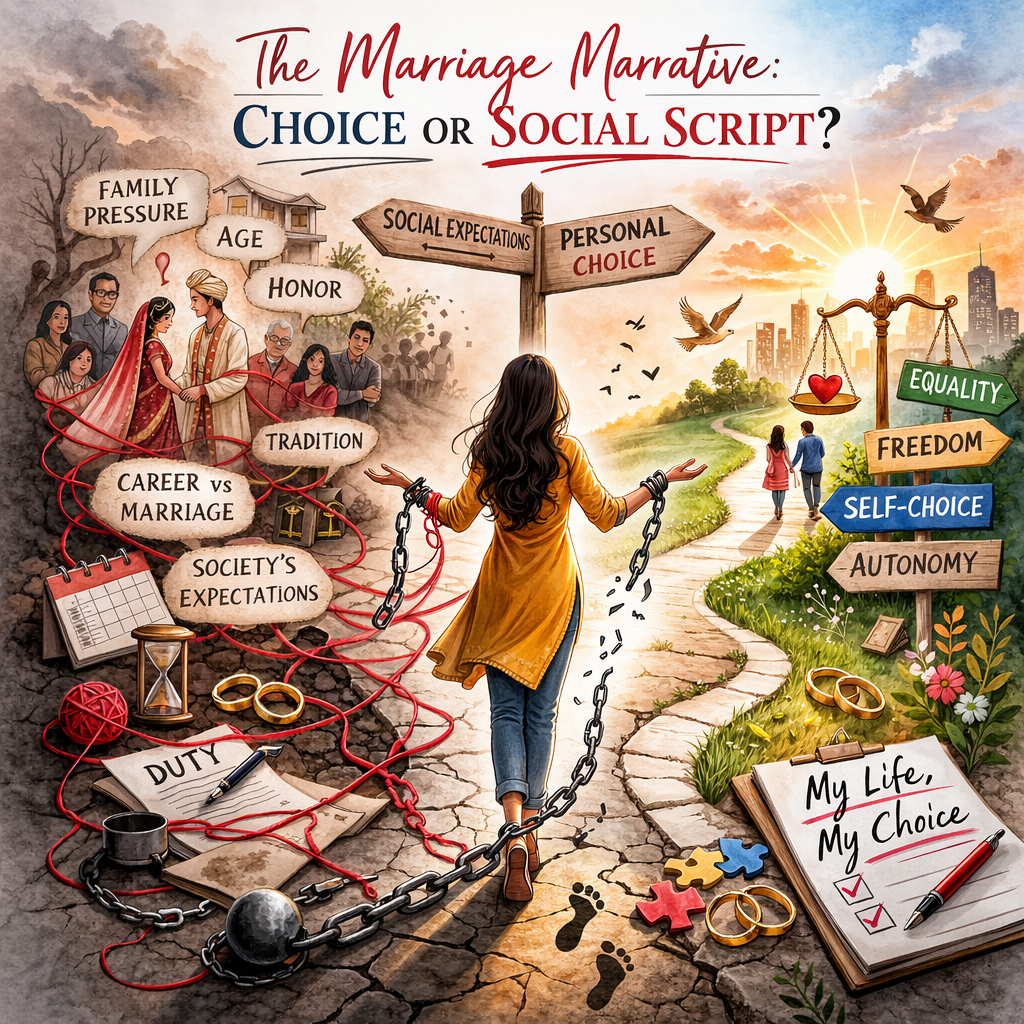
Have you ever stopped to wonder why almost every romantic movie ends exactly the same way? Two people meet, overcome an obstacle, and decide to spend the rest of their lives together. The screen fades to black, and we all assume they live happily ever after. We are taught from a very young age that finding a partner and settling down is the ultimate goal in life. But is this path truly something we choose, or is it just a story society wrote for us long before we were born?
Today, we often talk about marriage as an act of pure free will. We believe we pick our partners based on love and shared values. However, if we look closer at the numbers and the research, the picture gets a lot more complicated. As someone who cares deeply about personal freedom and true agency, I want to unpack this topic. We need to ask ourselves if we are actually making free choices or just following a very old script.
The Invisible Rules of Finding Love
When we talk about getting married, we like to think it is a completely personal decision. Yet, researchers Danica Aniciete and Kristy Lee Soloski note in their 2011 work that marriage is a socially constructed entity. This means that the rules, expectations, and even the timelines of marriage are built by the culture we live in.
We do not just wake up and decide what love should look like. Our culture feeds us ideas about:
- What age we should start looking for a partner
- What qualities make someone a good spouse
- How a relationship should progress from dating to living together to marriage
These invisible rules are so deeply baked into our daily lives that we rarely question them. When people stray from this path, society often views them with pity or suspicion. If marriage were entirely a personal choice, being single would be seen as an equally valid option. Instead, single people constantly face questions about when they will finally settle down. This social pressure shows that marriage is not just a choice. It is a social expectation.
Modern Choices and Global Scripts
You might be thinking that things are different now. People are marrying later, and arranged marriages are becoming less common in many parts of the world. Surely, this means we have more choice than ever before.
While it is true that things are shifting, the underlying script is still there. Keera Allendorf and Arland Thornton studied this shift in their research on developmental idealism. Their study, looked at how people in places like Nepal are changing their marriage behaviors. The researchers found that people are adopting modern ideas, such as choosing their own partners and delaying marriage.
However, these modern ideas are still part of a larger global script. Society simply swapped out one set of rules for another. The new script says that a modern, developed person chooses their own spouse and builds a nuclear family. We traded the traditional script for a modern one, but we are still reading from a script. The end goal remains the same, which is to form a legally and socially recognized partnership.
The Heavy Burden of Making the Right Choice
Framing marriage as a completely free choice creates a hidden trap, especially for women. When society tells you that your life partner is entirely your own choice, you carry all the blame if things go wrong.
Asha L. Abeyasekera explored this concept in a 2016 study on narratives of choice among urban middle-class women in Sri Lanka. The research showed that the freedom to choose comes with a massive burden. Women are expected to navigate complex social norms, maintain family honor, and still somehow make a choice that looks like pure romantic freedom.
If the marriage fails, society points the finger at the individual for picking the wrong person. This ignores the intense social pressures that push people into marriage in the first place. When we advocate for true equality, we have to recognize that wrapping social pressure in the language of choice does not make people free. It just makes them feel guilty when they cannot live up to an impossible standard.
Protecting Autonomy and Personal Freedom
To truly advocate for personal freedom, we must look at how the marriage script impacts basic rights. The push to marry and have a family often intersects with issues of bodily autonomy. Research from the Women’s Health Bulletin highlights how social and cultural factors heavily influence women’s reproductive rights and access to safe healthcare.
When a society values women primarily as wives and mothers, it often restricts their freedom to make choices about their own bodies. The marriage script can trap people in situations where they lose their voice. True advocacy means fighting for a world where people are valued for who they are as individuals, completely separate from their relationship status.
Furthermore, how couples view their own stories matters a great deal. Studies on marital quality,show that a shared understanding of the relationship helps it survive. But this shared reality should be built on mutual respect and genuine connection, not just a shared desire to meet societal expectations.
Rewriting the Story for Future Generations
We need to start having more honest conversations about why we do the things we do. If we want people to have true agency, we must stop treating marriage as a mandatory milestone for a successful life.
Here are a few ways we can begin to change the narrative:
- Celebrate milestones other than weddings and baby showers
- Stop asking single people when they plan to settle down
- Support laws and policies that protect individuals regardless of their marital status
- Encourage young people to define their own versions of happiness
Marriage can be a beautiful partnership when two people enter it freely and without pressure. But until we remove the heavy social script attached to it, we cannot call it a completely free choice. It is time we give ourselves, and each other, the permission to write our own stories.