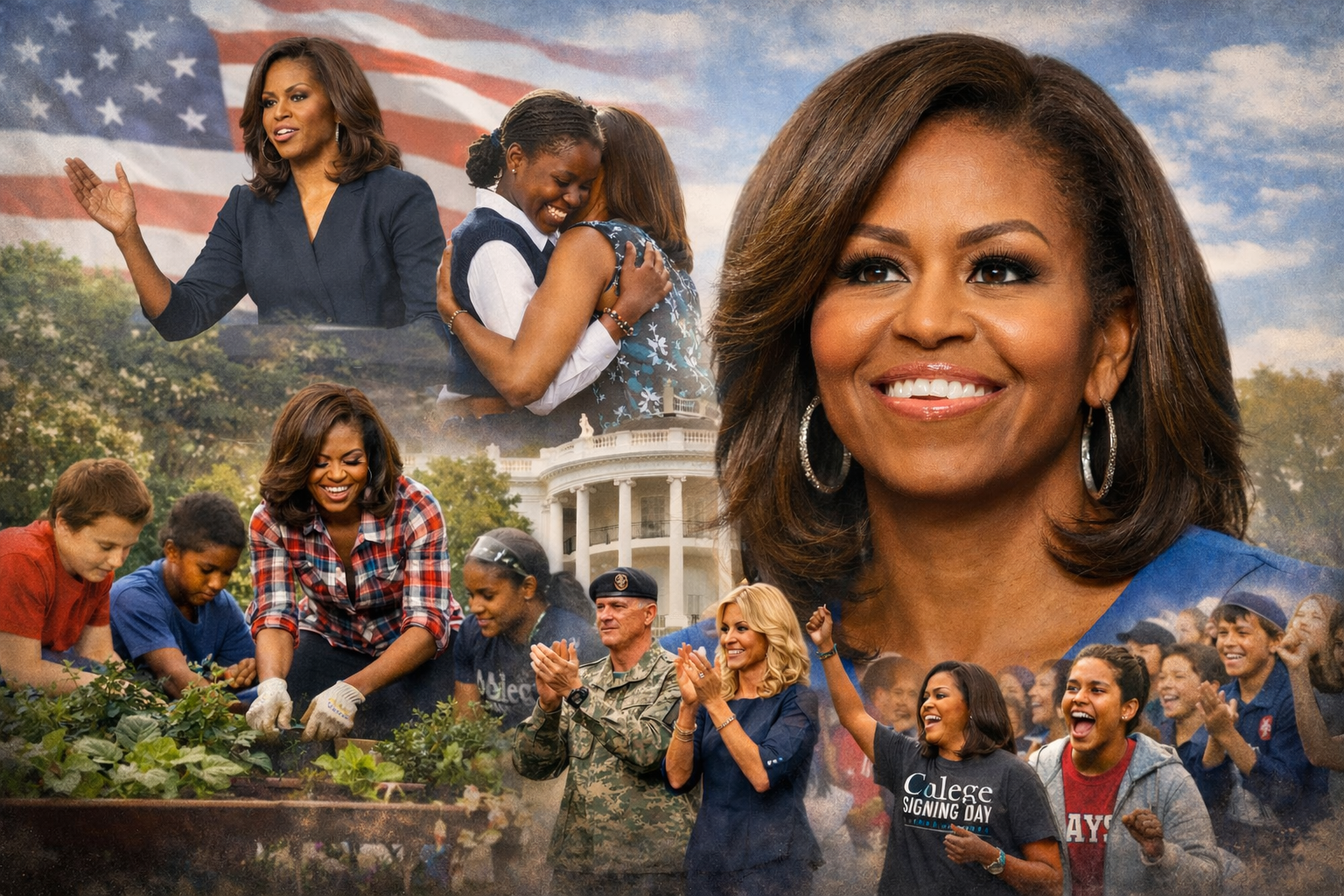
The role of the First Lady of the United States is uniquely complex, completely undefined by the Constitution, and deeply scrutinized by the public. For generations, the women who occupied the East Wing were largely expected to serve as gracious hostesses. They were tasked with selecting china patterns, organizing state dinners, and providing silent, unwavering support to their husbands. While many First Ladies subtly influenced policy or championed safe, non-controversial causes, the structural confines of the position remained rooted in traditional gender expectations. The public wanted a figurehead who was visible but not overly vocal, supportive but not inherently disruptive to the established political order.
This historical precedent shifted dramatically when Michelle LaVaughn Robinson Obama stepped onto the global stage. She did not merely fill the role. She fundamentally dismantled and rebuilt it. Through relentless advocacy, profound compassion, and incredibly powerful public engagement, she transformed the position into a dynamic platform for global change. As the first African American First Lady, she navigated a landscape fraught with unprecedented scrutiny, racial prejudice, and intense political polarization. Yet, she managed to transcend these obstacles, using her intellect, her authenticity, and her fierce commitment to marginalized communities to redefine what it means to be a woman in power. This deep dive explores the multifaceted journey of a leader who proved that profound influence requires neither an elected office nor a traditional political mandate.
The Crucible of the South Side: Foundations of a Leader
To understand the magnitude of Michelle Obama’s impact, one must first examine the roots from which she grew. Her story does not begin in the halls of power, but rather in a small brick bungalow on the South Side of Chicago. Born to Fraser and Marian Robinson, Michelle was raised in a working-class family that prioritized education, hard work, and unyielding integrity. Her father worked as a pump operator for the Chicago water department, a job he performed faithfully despite battling the debilitating effects of multiple sclerosis. Her mother stayed home to raise Michelle and her older brother, Craig, instilling in them a deep sense of self-worth and a profound understanding of their own potential.
The Robinson household was a crucible of intellectual curiosity. Marian and Fraser did not shelter their children from the realities of the world, nor did they treat them as fragile entities. Instead, they engaged them in robust conversations about race, class, and opportunity in America. This environment fostered a profound sense of groundedness in Michelle. She learned early on that success was not defined by wealth or status, but by the impact one had on their community.
Key Values Instilled in the Robinson Household:
- The Power of Voice: Marian Robinson taught her daughter to speak clearly and advocate for herself, refusing to let her children be silenced by adults or authority figures who underestimated them.
- The Importance of Education: Both parents viewed education as the ultimate equalizer, sacrificing their own comforts to ensure their children had access to the best possible schooling.
- Resilience in the Face of Adversity: Watching her father endure a progressive illness without complaint taught Michelle the true meaning of perseverance and quiet strength.
These early lessons served as the bedrock of her future advocacy. When she eventually reached the pinnacle of global prominence, she never lost sight of the working-class families, the struggling students, and the marginalized voices that mirrored her own upbringing. She brought the South Side of Chicago to the White House, ensuring that the “People’s House” truly reflected the diversity and the struggles of the American populace.
Academic Excellence and the Burden of Representation
Michelle Obama’s academic journey is a testament to her brilliant intellect and her unyielding determination to break through systemic barriers. When she arrived at Princeton University in the early 1980s, she found herself on a campus that was overwhelmingly white, male, and affluent. For a young Black woman from a public high school in Chicago, the transition was jarring. She often recounted the feeling of being an outsider, a sentiment exacerbated by the subtle and sometimes overt prejudices she encountered. Famously, the mother of her freshman roommate requested that her daughter be moved due to Michelle’s race.
Rather than shrinking in the face of this alienation, she leaned into her academic pursuits and found solace in the Third World Center (now the Carl A. Fields Center), a campus hub for students of color. It was here that she began to critically analyze the intersection of race, class, and social mobility. Her senior thesis, titled “Princeton-Educated Blacks and the Black Community,” explored the complex dynamics of upward mobility and the potential for elite-educated African Americans to become disconnected from their communities of origin. This academic exploration foreshadowed her lifelong commitment to ensuring that those who climb the ladder of success reach back to pull others up.
Following Princeton, she attended Harvard Law School, further cementing her status as a formidable intellectual force. However, her time at Harvard also solidified her understanding of the limitations of the corporate world. After graduating and accepting a lucrative position at the prestigious Chicago law firm Sidley Austin, she found herself unfulfilled. The work, while financially rewarding, lacked the deep sense of purpose she craved. It was during this period that she met a young summer associate named Barack Obama, a man whose passion for community organizing would mirror her own growing desire for public service.
Pivoting to Purpose: From Corporate Law to Community Empowerment
Michelle Obama’s decision to leave corporate law was a defining moment in her career trajectory. It marked a conscious pivot away from expected, traditional success toward a life dedicated to social impact. Long before she was known as a political spouse, she was a highly respected executive and community leader in her own right.
Her transition into public service began in the Chicago city government, where she worked as an assistant to the mayor and as the assistant commissioner of planning and development. In these roles, she learned the intricate mechanics of municipal governance and the importance of localized policy in shaping everyday lives. However, her true passion lay in direct community engagement.
In 1993, she became the founding executive director of the Chicago chapter of Public Allies, an AmeriCorps program dedicated to preparing young adults for careers in public service. Under her leadership, the organization thrived, breaking fundraising records and effectively empowering a new generation of community leaders. This role was pivotal. It allowed her to translate her belief in the potential of young people into actionable, structural support. She was not just talking about empowerment. She was building the pipelines to make it happen.
Her Pre-White House Leadership Roles Included:
- Public Allies Chicago: Fostering young leadership and creating pathways for marginalized youth to enter public service.
- University of Chicago: Serving as the Associate Dean of Student Services, where she developed the university’s first community service program.
- University of Chicago Hospitals: Acting as the Vice President for Community and External Affairs, bridging the massive gap between the elite medical institution and the surrounding low-income South Side neighborhoods.
These experiences fundamentally shaped her approach to the role of First Lady. She did not enter the White House as a blank slate or a mere extension of her husband’s political ambitions. She arrived as a seasoned executive with a proven track record of institutional reform, a deep understanding of community organizing, and a clear vision for how to leverage institutional power to enact tangible social change.
Navigating the Campaign Trail and Redefining Optics
The 2008 presidential campaign was a grueling test of endurance, strategy, and emotional fortitude. For Michelle Obama, it was also an introduction to the brutal machinery of national political media. As a highly educated, outspoken Black woman, she frequently found her words stripped of context, her tone scrutinized, and her character subjected to deeply unfair caricatures. The media often attempted to box her into the damaging trope of the “angry Black woman,” heavily policing her expressions of passion or frustration.
Her navigation of this treacherous landscape was a masterclass in poise and strategic communication. She recognized that her presence alone was a disruption to the historical norms of American politics. Instead of altering her core personality to fit a more docile, traditional mold, she leaned into her authenticity. She spoke candidly about the struggles of balancing a demanding career with motherhood. She openly discussed the financial anxieties that plague working-class families. She made herself relatable not by diminishing her intellect, but by sharing her universal experiences as a mother, a daughter, and a working professional.
By the time Barack Obama secured the presidency, Michelle had successfully redefined the optics of the political spouse. She had proven that a First Lady could be an equal partner, a formidable surrogate, and an independent thinker without eclipsing the presidency itself. The visual impact of a Black family entering the White House, a building constructed in part by enslaved people, was profoundly historic. Michelle Obama understood this weight and carried it with extraordinary grace, ensuring that the doors of the executive mansion were opened wider than ever before.
Advocacy Initiative: Let’s Move! and the Health of a Generation
Upon assuming the role of First Lady, Michelle Obama immediately sought to identify an initiative that was ambitious, measurable, and directly impactful on the lives of families. She chose to tackle the burgeoning crisis of childhood obesity. In 2010, she launched “Let’s Move!”, a comprehensive, multi-pronged campaign aimed at reversing the trend of childhood obesity within a generation.
This was not a simple public awareness campaign. It was a rigorous, policy-driven initiative that sought to fundamentally alter the landscape of childhood nutrition and physical activity in the United States. She understood that health is not merely a matter of personal choice, but a complex intersection of access, affordability, education, and corporate responsibility.
The Pillars of the Let’s Move! Campaign:
- Creating a Healthy Start for Children: Working with medical professionals and childcare centers to ensure healthy habits began in infancy.
- Empowering Parents and Caregivers: Providing families with clear, actionable information about nutrition, leading to the overhaul of the FDA’s Nutrition Facts label to make it more transparent and understandable.
- Providing Healthy Food in Schools: Championing the Healthy, Hunger-Free Kids Act, which updated school meal nutrition standards for the first time in fifteen years, significantly increasing the amount of fruits, vegetables, and whole grains served to millions of students daily.
- Improving Access to Healthy, Affordable Foods: Launching initiatives to eliminate “food deserts” in urban and rural communities, partnering with major retailers to open stores in underserved areas.
- Increasing Physical Activity: Collaborating with sports leagues, community organizations, and schools to ensure children received at least sixty minutes of active play per day.
Perhaps the most brilliant and symbolic aspect of this initiative was the creation of the White House Kitchen Garden. Located on the South Lawn, the garden was the first of its kind since Eleanor Roosevelt’s victory garden during World War II. By inviting local schoolchildren to plant and harvest the crops alongside her, she created a highly visible, engaging educational tool. The garden served as a living classroom, proving that healthy eating could be accessible, joyful, and deeply connected to the earth.
Advocacy Initiative: Joining Forces to Honor Military Families
While “Let’s Move!” focused on the nation’s children, Michelle Obama also recognized a critical need to support a highly specific, often overlooked demographic: the families of the United States armed forces. In 2011, she partnered with Dr. Jill Biden, then the Second Lady, to launch “Joining Forces.” This nationwide initiative called upon all Americans to rally around military members, veterans, and their families, ensuring they had the tools they needed to succeed throughout their lives.
Michelle Obama brought a deep sense of compassion to this work. She spent countless hours sitting with military spouses, listening to the immense challenges they faced. She heard stories of the emotional toll of multiple deployments, the academic disruptions faced by military children constantly moving between school districts, and the profound difficulties military spouses encountered when trying to maintain their own careers amidst constant relocation.
Key Achievements of Joining Forces:
- Employment: The initiative successfully secured commitments from thousands of companies to hire and train veterans and military spouses. By the end of the Obama administration, the program had facilitated over 1.2 million hires.
- Education: Joining Forces worked with all fifty states to sign the Interstate Compact on Educational Opportunity for Military Children, easing the transition for students moving across state lines. It also pushed for the widespread adoption of policies to help veterans translate their military training into academic credit.
- Wellness: The campaign focused heavily on mental health, partnering with medical organizations to ensure healthcare providers were adequately trained to recognize and treat the invisible wounds of war, such as Post-Traumatic Stress Disorder (PTSD) and Traumatic Brain Injury (TBI).
Through Joining Forces, Michelle Obama utilized her unparalleled convening power to bring together the public and private sectors, demanding structural support for those who sacrifice for the nation. She transformed the rhetoric of “supporting the troops” into actionable, measurable policy changes that directly improved the livelihoods of military families.
Advocacy Initiative: Reach Higher and the Promise of Education
Education had always been the great equalizer in Michelle Obama’s own life, and she was determined to make that reality accessible to every young person in America. Understanding that a high school diploma was no longer sufficient for success in the modern global economy, she launched the “Reach Higher” initiative in 2014.
The goal of Reach Higher was deeply personal: to inspire every student in America to take charge of their future by completing their education past high school, whether at a professional training program, a community college, or a four-year college or university. This initiative was specifically targeted at first-generation college students and those from low-income backgrounds, demographics that often lack the institutional knowledge required to navigate the complex college admissions and financial aid processes.
Strategic Components of Reach Higher:
- Financial Aid Literacy: The initiative heavily promoted the completion of the Free Application for Federal Student Aid (FAFSA), demystifying the process and helping students access billions of dollars in available federal funding.
- Summer Learning: Providing resources and support to combat the “summer slide,” ensuring students remained academically engaged outside of the traditional school year.
- College Signing Day: In a brilliant cultural shift, Michelle Obama created “College Signing Day.” Traditionally reserved for elite high school athletes announcing their university commitments, she repurposed the concept to celebrate everyday students making the commitment to pursue higher education. She enlisted celebrities, professional athletes, and public figures to wear their college apparel, creating a massive, joyful, and highly visible celebration of academic achievement.
- School Counselor Support: Recognizing the incredibly difficult job of high school guidance counselors, Reach Higher actively worked to elevate their profession, advocating for smaller student-to-counselor ratios and providing platforms for professional development.
By sharing her own stories of imposter syndrome and the challenges she faced as a first-generation student at Princeton, she demystified the college experience. She made higher education feel attainable, replacing the intimidation of the process with a sense of collective encouragement and relentless support.
Advocacy Initiative: Let Girls Learn and Global Empowerment
Michelle Obama’s advocacy was not confined to the borders of the United States. In 2015, she and the President launched “Let Girls Learn,” an expansive, cross-governmental initiative aimed at addressing the complex barriers that prevent more than 62 million adolescent girls worldwide from attending and completing school.
This initiative was born from a profound recognition of gender inequity on a global scale. The First Lady understood that when girls are denied an education, it is not simply an individual tragedy; it is an economic and societal failure. Uneducated girls are more likely to be subjected to forced marriages, face higher risks of maternal mortality, and remain trapped in cycles of extreme poverty. Conversely, educating girls transforms communities, boosts national economies, and fundamentally shifts the trajectory of future generations.
Let Girls Learn was unique in its structural approach. It leveraged the resources of multiple federal agencies, including the Department of State, the United States Agency for International Development (USAID), and the Millennium Challenge Corporation. Crucially, it deeply integrated the Peace Corps, empowering thousands of volunteers to work directly with local leaders to identify and dismantle the specific, localized barriers to girls’ education.
Addressing Complex Global Barriers:
- Infrastructure: Building safe school environments, ensuring access to clean water, and constructing separate sanitation facilities for adolescent girls.
- Economic Support: Providing scholarships, reducing school fees, and creating programs to help families offset the economic loss of sending a daughter to school rather than keeping her home to work.
- Cultural Shifts: Engaging community elders, religious leaders, and men and boys to shift deep-rooted cultural paradigms that devalue the education of women.
Michelle Obama traveled extensively to promote this cause, visiting schools and meeting with young women in countries like Liberia, Morocco, Spain, and Japan. Her message was unwavering: the intellect and potential of young women are the world’s most underutilized resources. Through Let Girls Learn, she elevated the conversation around global gender equity from a niche philanthropic interest to a central pillar of international diplomacy.
The “Mom-in-Chief” and the Power of Authenticity
While her policy initiatives were rigorous and deeply impactful, Michelle Obama’s most profound tool may have been her own public persona. Early in her tenure, she self-identified as the “Mom-in-Chief,” a moniker that drew both praise and criticism. Some observers worried that the title diminished her brilliant legal mind and her executive experience. However, an in-depth analysis reveals that this was a highly strategic and remarkably effective framing device.
By leading with her identity as a mother, she immediately disarmed partisan hostility. Motherhood is a universally understood language. It allowed her to build a bridge of empathy with women across the political spectrum. When she spoke about the challenges of limiting her daughters’ screen time, the difficulty of getting them to eat vegetables, or her fierce desire to protect their privacy in the glaring spotlight of the global media, she became profoundly relatable. She was not just a political figure. She was a working mother trying to do her best.
This authenticity was not a performance. It was a conscious decision to remain grounded in her own reality. She famously insisted on maintaining a level of normalcy for Malia and Sasha, requiring them to make their own beds, complete their chores, and understand that the privileges of the White House were temporary.
Furthermore, her authenticity extended to her engagement with popular culture. Michelle Obama understood that to reach the American people, she had to go where they were. She did not limit her appearances to Sunday morning political talk shows. She appeared on late-night television, engaging in push-up contests with Ellen DeGeneres. she participated in highly viral “Carpool Karaoke” segments with James Corden, belting out Stevie Wonder and Missy Elliott. She danced on the Disney Channel and made cameos on popular sitcoms.
This mastery of modern media was unprecedented for a First Lady. It was not frivolous. It was a calculated, joyful method of communication that allowed her to bypass traditional political filters and deliver her messages directly to the public. She used humor, warmth, and an unmistakable sense of cool to make the White House feel accessible, vibrant, and alive.
Fashioning a Message of Inclusion and Diplomacy
In the history of the First Ladyship, fashion has always been a subject of public fascination. Michelle Obama, however, transformed her wardrobe from a subject of mere aesthetic critique into a powerful tool of diplomacy and economic empowerment. She recognized that every outfit she wore would be photographed, analyzed, and archived. Therefore, she used her sartorial choices to send deliberate, strategic messages.
Rather than exclusively favoring established, legacy European fashion houses, she actively championed young, emerging, and diverse American designers. When she wore a gown by a then-unknown Jason Wu to the 2009 inaugural ball, she instantly launched his career onto the global stage. She wore designs by Christian Siriano, Prabal Gurung, and Tracy Reese, utilizing her immense visibility to uplift minority designers and small business owners.
Her fashion was also a masterclass in soft diplomacy. During state dinners and international trips, she meticulously selected designers whose backgrounds or aesthetics paid homage to the host nation or the visiting dignitaries. It was a subtle but profound gesture of respect and cultural appreciation.
Moreover, she democratized fashion. She was frequently photographed wearing accessible brands like J.Crew, Target, and Gap, mixing high-end pieces with affordable staples. This approach further cemented her relatability. She demonstrated that elegance and style were not strictly the domain of the ultra-wealthy, but could be attained and celebrated by the average American woman.
A Voice of Conscience: The Power of Oratory
As her tenure progressed, Michelle Obama emerged not only as an advocate and a cultural icon, but as one of the most gifted and resonant orators of her generation. Her speeches transcended typical political rhetoric. They were deeply rooted in morality, empathy, and an unwavering demand for human dignity.
Perhaps the most defining moment of her public speaking career occurred at the 2016 Democratic National Convention. In a political climate characterized by deep division, hostility, and incredibly toxic rhetoric, she delivered an address that galvanized the nation. She spoke movingly about the historical arc of the country, noting the profound reality of waking up every morning “in a house that was built by slaves,” and watching her daughters play on the lawn. It was a masterful weaving of personal narrative, historical reckoning, and patriotic optimism.
It was in this speech that she introduced the phrase that would become a global mantra: “When they go low, we go high.” This was not a call for passivity or weakness. It was a profound demand for moral discipline. It was an instruction to refuse to engage in the degradation of political discourse and to maintain one’s integrity in the face of cruelty.
Later that same year, during a campaign stop in New Hampshire, she delivered another historically significant speech addressing the mistreatment of women. Responding to the deeply troubling rhetoric surrounding the election, she spoke with visible emotion, her voice shaking with righteous indignation. She articulated the collective trauma and exhaustion experienced by women navigating a world of systemic disrespect. “It has shaken me to my core in a way that I couldn’t have predicted,” she stated. She refused to brush the behavior off as “locker room talk,” calling it what it was: an affront to basic human decency.
In these moments, she was not speaking as a politician. She was speaking as a fiercely protective mother, a woman who had navigated systemic barriers, and a moral leader demanding better from her country. Her ability to articulate the unspoken anxieties and hopes of millions of people cemented her legacy as a profound voice of conscience.
Becoming and the Post-White House Legacy
The transition out of the White House is a notoriously difficult period for former Presidents and First Ladies, as they attempt to define their next chapter. For Michelle Obama, leaving the East Wing was not an ending, but a massive expansion of her influence.
In 2018, she released her memoir, Becoming. The book was a global phenomenon, selling millions of copies and breaking publishing records worldwide. Becoming was a masterclass in vulnerability. She did not write a sanitized, self-congratulatory political memoir. Instead, she offered a deeply intimate look at her life, discussing her struggles with fertility and the isolation of undergoing IVF. She wrote about the difficulties of marriage counseling and the strain that political ambition placed on her relationship.
By sharing her vulnerabilities so openly, she shattered the illusion of perfection that often surrounds public figures. She gave permission to millions of readers to embrace their own messy, complex journeys. The subsequent book tour was less of a traditional literary event and more of a global empowerment rally, filling massive arenas with diverse audiences hungry for her wisdom and authenticity.
Continuing the Work of Empowerment:
- Higher Ground Productions: Partnering with Netflix to create documentaries and films that elevate marginalized voices and tell complex, untold stories.
- The Light We Carry: Her follow-up book, offering practical wisdom and strategies for finding hope and maintaining resilience in highly uncertain times.
- When We All Vote: A nonpartisan initiative launched to increase voter participation, deeply reflecting her foundational belief in the power of civic engagement and the importance of ensuring every voice is heard in the democratic process.
Her post-White House endeavors demonstrate a continued, unyielding commitment to the same principles that guided her early career in Chicago. She remains dedicated to equipping people, particularly youth and marginalized communities, with the tools they need to define their own futures.
Conclusion: A Blueprint for the Future
Michelle Obama entered the White House as the first African American First Lady, carrying the immense weight of historical expectation and unprecedented scrutiny. She left the East Wing having fundamentally transformed the institution. She proved that the role of the political spouse does not require the suppression of one’s intellect, passion, or personality.
Through her rigorous policy initiatives like Let’s Move! and Reach Higher, she demonstrated how the convening power of the office could be used to enact tangible, lasting change. Through her global advocacy with Let Girls Learn, she elevated the cause of women’s education to the forefront of international diplomacy. And through her incredible mastery of modern communication, her profound empathy, and her moral clarity, she forged a deeply personal connection with people across the globe.
She redefined the role not by rejecting its traditions, but by vastly expanding its boundaries. She infused the position with compassion, fierce advocacy, and a joyous, vibrant authenticity. In doing so, she did not just support a presidency. She provided a brilliant, enduring blueprint for leadership, proving that true power lies in the unwavering commitment to lifting others up. Michelle Obama’s legacy is not confined to the history books of a single administration. It lives on in the millions of young people she inspired to reach higher, to embrace their own becoming, and to always, even in the darkest of times, go high.
Leave a Reply