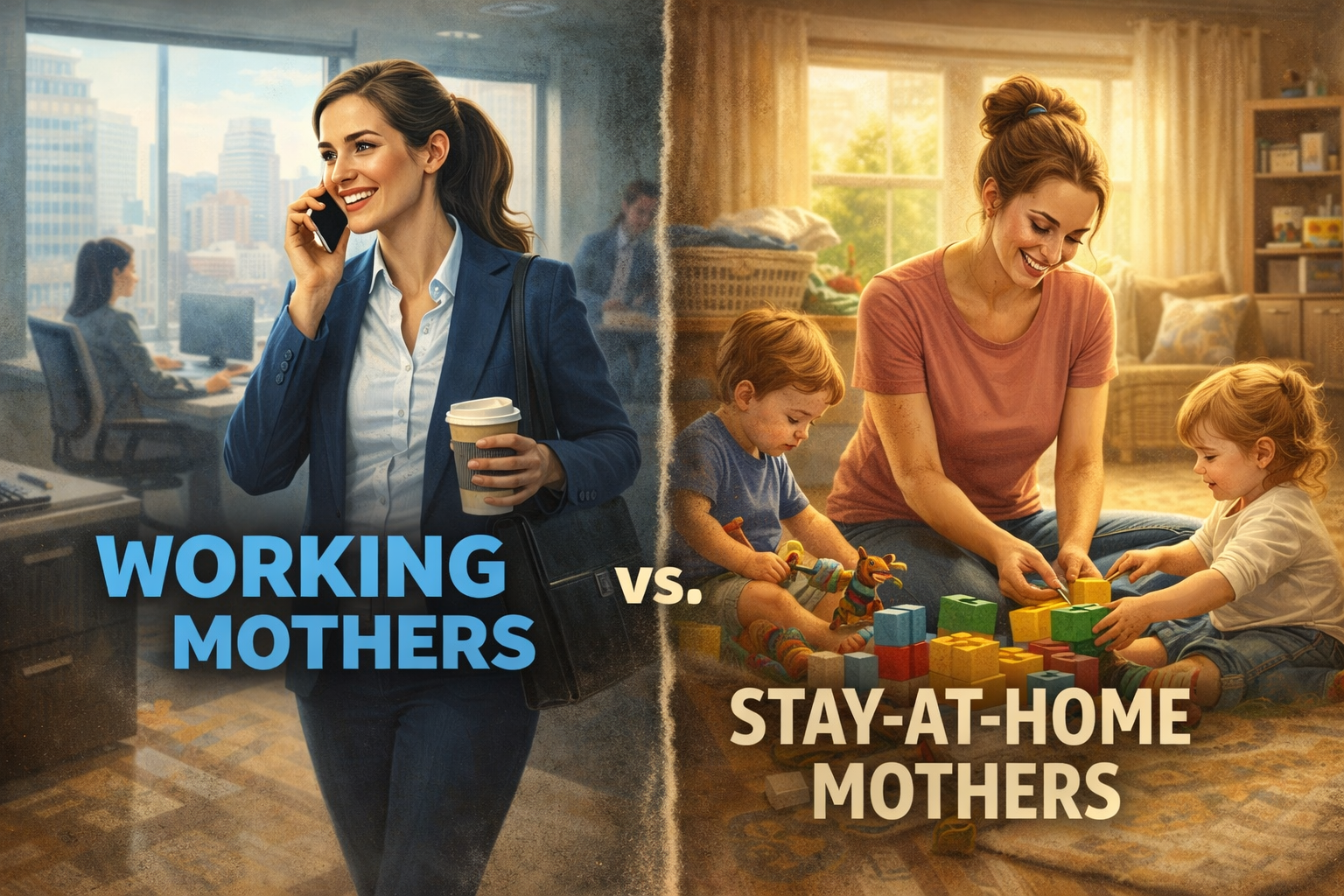
The cultural narrative loves a rivalry. We see it in movies, read it in magazines, and feel it in the passive aggressive comments exchanged at playgrounds or in office breakrooms. On one side stands the career driven mother. She is often portrayed as armed with a briefcase and a smartphone, supposedly neglecting her family in the name of ambition. On the other side stands the stay-at-home mother. She is frequently depicted as covered in pureed carrots, supposedly throwing away her intellectual potential for domestic martyrdom. This manufactured conflict has a well known name. It is called the Mommy Wars.
This persistent cultural fixation on pitting women against one another serves a very specific purpose, though rarely one that benefits women themselves. By keeping mothers locked in a state of mutual judgment, society successfully diverts attention away from the glaring structural failures that make parenting an exhausting endeavor for nearly everyone. When we argue over whose daily routine is more challenging, we fail to look upward at the systems that have abandoned us all.
The truth is that this dichotomy is deeply flawed. It relies on the false premise that raising children is not inherently work. It also relies on the delusion that the modern workplace is designed to accommodate the realities of human caregiving. This article will dissect the unique struggles faced by women in both categories, explore the illusion of choice, and argue for a radical shift in how we value labor, care, and each other.
The Architecture of a Manufactured Rivalry
To understand why this debate is so pervasive, we must examine who profits from the friction. The rivalry between mothers is not a natural occurrence. It is a byproduct of an economic structure that refuses to accommodate the realities of human life.
Before the Industrial Revolution, the home and the workplace were largely the same geographic location. Families worked the land or ran small businesses together. Caregiving and economic production were deeply intertwined. However, industrialization forcibly separated these spheres. Factories demanded labor outside the home, establishing a physical and ideological divide between money making and caretaking. This historical shift laid the groundwork for the modern dilemma, forcing individuals to navigate two entirely separate physical and mental spaces.
The nuclear family model of the mid twentieth century established a rigid binary based on this division. Men were designated as the public providers, while women were relegated to the private sphere of unpaid domestic labor. When women began entering the paid workforce in larger numbers, the structures of society did not adapt to support them. Workplaces continued to operate under the assumption that every employee had a full time caregiver managing their home life. Meanwhile, the value of domestic labor remained completely unacknowledged in terms of economic metrics like the Gross Domestic Product.
This created a trap. Women who entered the workforce faced an environment deeply hostile to their dual roles. Women who stayed home found their contributions financially devalued and socially diminished. Instead of recognizing that both groups were struggling against an unyielding system, a narrative of scarcity took hold. Society began to imply that there was only one correct way to be a mother. If a woman chose a career, she was labeled selfish. If she chose the home, she was labeled submissive.
This judgment is a brilliant distraction technique. As long as mothers are looking sideways to criticize the choices of their peers, they are not looking up to demand better policies. They are not organizing for universal childcare, paid family leave, or flexible working hours. The debate creates a smokescreen that protects corporations and governments from having to invest in the infrastructure of care. Ultimately, the rivalry ensures that the burden of raising the next generation remains a strictly individual problem rather than a collective social responsibility.
The Unforgiving Terrain of the Dual Role
For the mother who participates in the paid labor force, the challenges are multifaceted and relentless. The most glaring issue is the phenomenon sociologists refer to as the second shift. After completing a full day of paid work, the working mother returns home to begin her second job. This second job consists of cooking, cleaning, organizing, and providing emotional support for her family. Despite decades of progress in gender equality, studies consistently show that women still shoulder the vast majority of domestic responsibilities, even when they earn the primary income.
In the professional realm, mothers face documented discrimination known as the motherhood penalty. While men often receive a wage increase after having children, a phenomenon known as the fatherhood bonus, women experience a significant decrease in their earnings trajectory. Employers frequently, and often subconsciously, assume that a mother will be less committed to her job. She is passed over for promotions, excluded from high stakes projects, and penalized for needing flexibility. The corporate ladder was built for an employee who has no competing obligations, making it an incredibly precarious climb for anyone with caregiving responsibilities.
Beyond the structural and financial hurdles, there is an immense psychological toll. Working mothers operate under a heavy blanket of guilt. They feel guilt for missing bedtime stories because of a late meeting, and they feel guilt for missing a deadline because of a sick child. The cultural expectation is that a woman should work as if she does not have children and raise children as if she does not have a job. This impossible standard creates a constant state of perceived failure.
Furthermore, the mental load required to manage two entirely separate spheres of existence is staggering. The working mother is often the designated project manager of the household. She is the one keeping track of doctor appointments, school forms, grocery lists, and shoe sizes, all while managing her professional inbox. This invisible cognitive labor leads to profound burnout. The exhaustion is not just physical. It is a deep, soul wearying fatigue born from the demand to be entirely present in two contradictory worlds simultaneously.
The Invisible Economy of Domestic Labor
Conversely, the stay-at-home mother navigates a completely different, yet equally treacherous, landscape. The primary challenge here is the profound societal devaluation of unpaid care work. In a capitalist framework, value is determined almost exclusively by monetary compensation. Because raising children and managing a household do not generate a paycheck, this labor is often dismissed as entirely leisurely or, worse, inherently natural and therefore undeserving of recognition.
The reality is that stay-at-home mothers are the invisible infrastructure that holds society together. They are early childhood educators, chefs, logistics coordinators, nurses, and conflict resolution specialists. If a family had to outsource all these tasks to paid professionals, the cost would be astronomical. Yet, because this labor is performed out of love and familial obligation, it is entirely stripped of economic power.
This lack of financial compensation places stay-at-home mothers in a position of extreme vulnerability. Financial dependence on a partner can become a significant risk factor. In the event of death, divorce, or economic downturn, the woman who has stepped out of the workforce for several years faces a terrifying reality. She has no recent resume, no independent retirement savings, and often no immediate way to support herself. The sacrifice of her earning potential is rarely compensated or protected by legal or social safety nets.
Additionally, the daily reality of being at home with young children is incredibly isolating. The modern neighborhood is largely empty during the day, severing the communal networks that historically supported mothers. The work is repetitive, relentless, and completely lacking in the standard markers of achievement found in the professional world. There are no performance reviews, no promotions, and very few moments of adult validation.
The stay-at-home mother also faces a unique brand of cultural condescension. She is frequently asked what she does all day, an insulting question that implies her time is spent in idle relaxation. The loss of personal identity is a common and painful experience. When a woman’s entire existence is defined by her service to others, finding space for her own ambitions, hobbies, or simple quiet reflection becomes nearly impossible.
Privilege and the Illusion of Autonomy
A critical flaw in the debate between working and stay-at-home mothers is the assumption that every woman has the luxury of making a choice. For a massive percentage of the population, the decision is entirely dictated by economic reality rather than personal philosophy. By framing motherhood as a simple lifestyle preference, we erase the lived experiences of marginalized women, single mothers, and those living in poverty.
For many families, two incomes are not a choice geared toward career fulfillment. Two incomes are a basic survival requirement to cover rent, groceries, and healthcare. Working class women and women of color have always participated in the paid labor force, often caring for the children of wealthier families while struggling to provide for their own. The idealized vision of the stay-at-home mother was historically reserved for white, middle class, and upper class women. It is a vision built on exclusivity.
On the other end of the spectrum, many women are forced out of the workforce entirely due to the catastrophic cost of childcare. In numerous regions, the monthly cost of a daycare center rivals or exceeds a mortgage payment. If a mother’s salary barely covers the cost of paying someone else to watch her child, staying home becomes a mathematical necessity rather than a joyful calling. This is not an empowered choice. It is a systemic eviction from the economy.
When we talk about empowering women, we must recognize that true autonomy requires a foundation of supportive options. A choice is only a true choice if both paths are viable, supported, and respected. Currently, we offer women two broken paths. We offer them a workforce that penalizes their biological realities, or we offer them a domestic sphere that strips them of financial security. Until society provides the infrastructure necessary to make both options safe and sustainable, the concept of choice remains an illusion reserved for the highly privileged.
A New Vocabulary for Solidarity
To move forward, we must vehemently reject the premise of the Mommy Wars. We must refuse to participate in the judgment of other women, and more importantly, we must redirect our collective frustration toward the systems that are failing us all. This requires a new vocabulary, one rooted in fierce solidarity and clear political demands.
- Demand Structural Workplace Reform: This includes mandatory, fully paid family leave for all parents, regardless of gender. When men are also expected and encouraged to take time off for caregiving, the motherhood penalty begins to dissolve. We must also demand flexible working arrangements, remote options, and an end to the culture of chronic overwork. Productivity should not be measured by physical presence in an office chair at the expense of family life.
- Fight for Universal Childcare: Childcare is not a private luxury. It is a public good, much like roads, libraries, and public schools. When we treat childcare as essential infrastructure, we allow women to participate in the economy without sacrificing their financial futures or the well being of their children.
- Renegotiate Domestic Labor: We need a cultural revolution within the home itself. The division of domestic labor must be radically updated. Heterosexual partnerships must move past the outdated concept of the man simply helping out and move toward a model of true equitable management. This means sharing not only the physical tasks of cleaning and cooking but also the invisible mental load of planning and organizing household life.
- Elevate All Care Work: Furthermore, our solidarity must extend to the professional care workers we employ. The women who staff daycares, nanny our children, and clean our homes are often significantly underpaid and lack basic labor protections. Elevating the status of motherhood requires elevating the status of all care work. We cannot demand equity in our corporate offices while relying on the exploitation of other women, disproportionately women of color, to manage our domestic lives.
Finally, we must fundamentally redefine how we value labor. Care work is the foundation upon which all other economic activity is built. Without the unpaid labor of caregivers, the paid workforce would collapse overnight. We must begin to culturally and economically honor the profound contribution of those who raise the next generation. Whether this labor is performed by a mother who stays home, a mother who works a second shift, or a paid domestic worker, it is worthy of immense respect and protection.
Conclusion
The debate between working mothers and stay-at-home mothers is a relic of a patriarchal system that thrives on our division. It is time to lay down the weapons we have been handed and recognize our shared struggles.
Every mother is a working mother. Some are compensated with a paycheck and penalized by corporate culture, while others are compensated with immense love and penalized by economic invisibility. Neither path is easy, and neither path is superior.
Our power lies in our unity. When we stop viewing each other as competition and start viewing each other as allies, we become an unstoppable force for change. We can build a world where career ambition and caregiving are not mutually exclusive. We can create a society that catches us when we fall, supports us when we struggle, and honors the monumental task of raising human beings. It is time to end the comparisons, silence the judgment, and demand a world that finally works for all mothers.
Leave a Reply