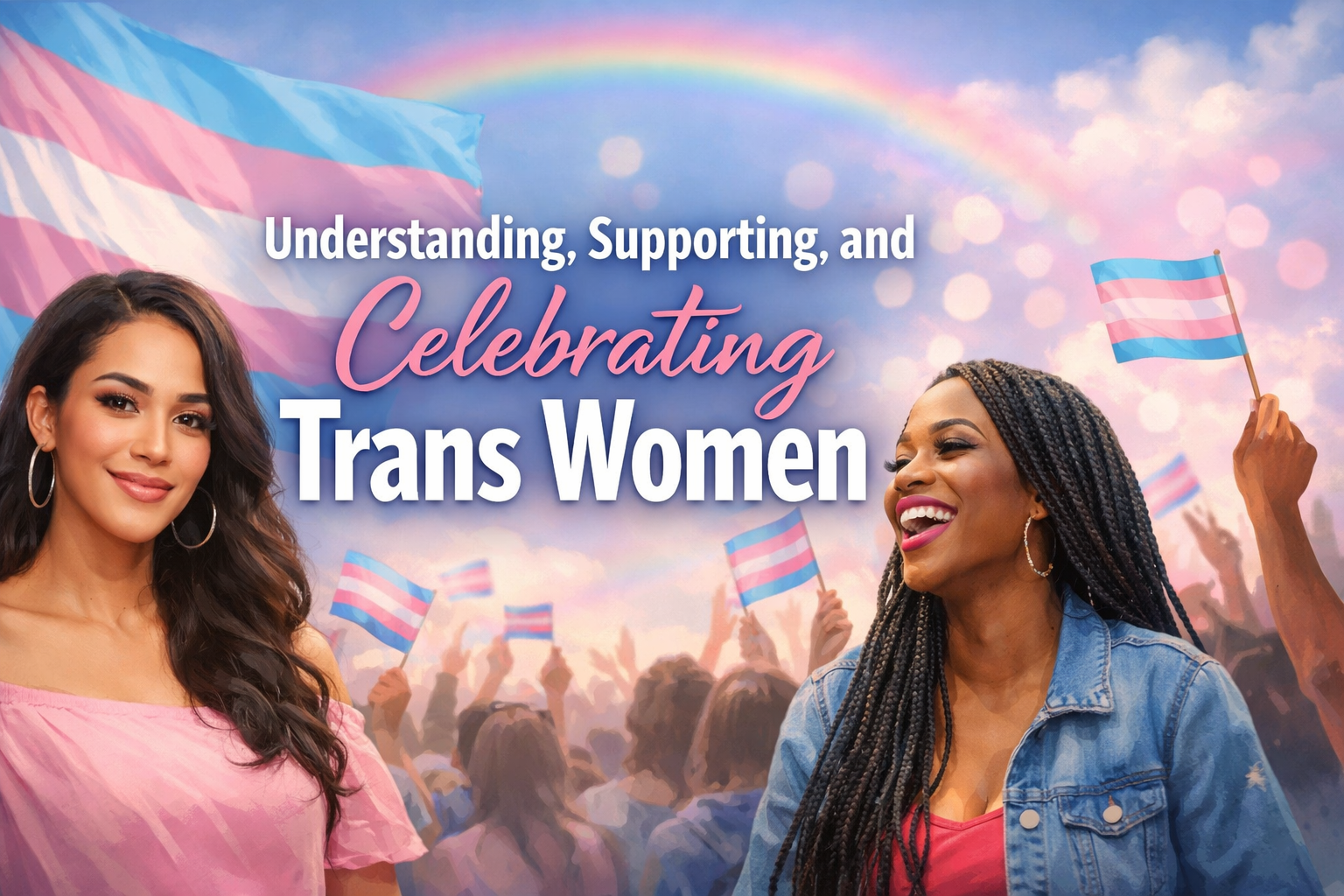
If you have turned on the news, opened a social media app, or paid attention to global political debates at any point in the last few years, you have undoubtedly heard about transgender people. More specifically, you have likely seen an overwhelming amount of discourse centered around trans women. In recent years, trans women have found themselves at the epicenter of a cultural earthquake, subject to hyper-visibility in the media, in sports regulations, and in legislative chambers around the world.
But beneath the loud political talking points, the sensationalized headlines, and the often-vitriolic debates, there is a fundamental truth that frequently gets lost in the noise: trans women are human beings. They are our sisters, daughters, friends, colleagues, and neighbors. They are artists, scientists, athletes, and activists. And like anyone else, they are simply navigating the complexities of life, seeking happiness, safety, and the freedom to live authentically.
This comprehensive guide aims to cut through the misinformation and the political theater. Over the next few thousand words, we will explore the reality of what it means to be a trans woman today. We will delve into the historical legacy of trans women, the science and sociology of gender, the unique and intersectional challenges they face in the modern world, and the actionable ways that cisgender people (those whose gender identity aligns with the sex they were assigned at birth) can step up as genuine allies.
Whether you are looking to educate yourself for a loved one, or you simply want to better understand the diverse tapestry of the human experience, this is a space for empathy, facts, and candor.
Decoding Gender: What It Means to Be a Trans Woman
To understand the lived experience of a trans woman, we first need to unpack the terminology and correct some widespread societal misconceptions about sex and gender.
A trans woman (note the space between the words, using “trans” as a descriptive adjective rather than a distinct noun) is a woman who was assigned male at birth. When she was born, a doctor looked at her physical anatomy and declared, “It’s a boy,” and society proceeded to raise her under the expectations, norms, and roles associated with boyhood and manhood. However, as she grew and developed a conscious understanding of her internal self, she realized that this external assignment did not match her deep, inherent sense of who she is. Her gender identity—her internal compass of being—is female.
For generations, Western society conflated sex and gender, treating them as interchangeable synonyms. Modern science, sociology, and psychology recognize that they are distinct concepts:
- Biological Sex: This is a complex combination of physical traits, including chromosomes (XX, XY, etc.), reproductive anatomy, hormones, and secondary sex characteristics. Even biological sex is not a strict binary; millions of intersex people are born with biological traits that do not fit neatly into typical definitions of male or female.
- Gender Identity: This is a person’s deeply felt, internal, and psychological sense of their own gender. It is how you experience your own selfhood in your brain and soul.
- Gender Expression: This is how a person presents their gender to the outside world through clothing, behavior, voice, haircuts, and mannerisms.
For trans women, the friction between their assigned sex at birth and their internal gender identity often results in gender dysphoria. Dysphoria is a profound psychological distress that arises from this mismatch. It can feel like wearing a heavy, ill-fitting costume that you cannot take off, or hearing your name called but feeling like they are speaking to a stranger.
However, being a trans woman is not solely defined by the pain of dysphoria. It is equally defined by gender euphoria—the immense, radiant joy, comfort, and profound rightness that occurs when a trans woman is seen, referred to, and allowed to exist as her true self.
A Legacy of Resilience: Trans Women Throughout History
One of the most persistent and damaging myths about trans people is that being transgender is a “new trend” or a modern social contagion born out of internet culture. Nothing could be further from the truth. Trans women have existed in every civilization, on every continent, since the dawn of recorded human history. They have simply been subjected to centuries of systemic erasure.
In many pre-colonial and non-Western cultures, gender variance was not just tolerated; it was revered.
- In the Indian subcontinent, the Hijra community (which includes trans women, intersex people, and eunuchs) has a recorded history stretching back thousands of years to ancient Hindu texts. They have traditionally held specific religious and ceremonial roles.
- In Oaxaca, Mexico, the Indigenous Zapotec culture recognizes the Muxe, individuals assigned male at birth who dress and behave in ways associated with women, forming a celebrated third gender.
- In Samoa, the Fa’afafine are an integral part of traditional society, recognized as a distinct gender identity that embodies both masculine and feminine traits.
- In Thailand, Kathoey are a highly visible part of the cultural landscape.
Even in modern Western history, trans women have been the architects of liberation. You cannot talk about the modern LGBTQ+ rights movement without talking about trans women of color.
Marsha P. Johnson and Sylvia Rivera, two prominent trans women (and self-identified drag queens/street queens of the era), were pivotal figures in the 1969 Stonewall Uprising in New York City, the catalyst for the modern gay rights movement. They went on to found STAR (Street Transvestite Action Revolutionaries), an organization dedicated to providing housing and support for homeless queer youth and sex workers. They fought fiercely for liberation at a time when the broader gay rights movement often tried to push them into the shadows for the sake of “respectability.”
Other historical pioneers include Lili Elbe, a Danish painter and one of the first known recipients of gender-affirming surgery in the early 20th century, and Christine Jorgensen, an American trans woman who became an international sensation in the 1950s, using her platform to advocate for understanding and scientific research into gender transition.
Trans women have always been here. The only thing that is new is the mainstream media’s willingness to report on them, and the coordinated political backlash against their visibility.
The Intersectional Realities of Today
To truly understand the modern trans experience, we must view it through the lens of intersectionality. Coined by legal scholar Kimberlé Crenshaw in 1989, intersectionality is the framework that explains how various forms of inequality and identity—such as race, class, gender, and sexuality—operate together and exacerbate one another.
A trans woman does not just experience the world through the lens of being trans; she experiences it based on her race, her economic status, and her physical abilities. The specific type of discrimination faced by trans women is often called transmisogyny (the intersection of transphobia and misogyny), and for Black trans women, this is compounded by racism to create transmisogynoir.
The data paints a sobering picture of these overlapping marginalizations. According to major demographic analyses (such as data released in 2025 by the Williams Institute), over 2.8 million people in the United States identify as transgender, with trans women making up roughly a third of that adult population. While visibility has increased, so has the targeted backlash.
“All inequality is not created equal. We tend to talk about race inequality as separate from inequality based on gender, class, sexuality or immigrant status. What’s often missing is how some people are subject to all of these, and the experience is not just the sum of its parts.” — Kimberlé Crenshaw
When we look at global health and safety statistics, the intersectional disparities are staggering.
- Violence and Murder: Global data consistently shows that the vast majority of anti-trans violence is directed at trans women of color. According to the 2025 Trans Murder Monitoring (TMM) report by TGEU, 90% of reported trans murders globally were feminicides (victims were trans women or transfeminine). Shockingly, 88% of those victims were Black or Brown trans people.
- Healthcare Disparities: Recent major US cohorts analyzing HIV acquisition among trans women revealed sharp racial disparities. The incidence of HIV is exponentially higher for Black, Latina, and Asian trans women compared to white trans women. This is not due to biology, but rather systemic marginalization: housing insecurity, employment discrimination, and the resultant reliance on survival sex work.
- Employment and Poverty: Trans women—especially women of color—are routinely pushed out of formal employment sectors due to bias, leading to disproportionate rates of poverty and homelessness.
Understanding intersectionality means recognizing that we cannot advocate for women’s rights or LGBTQ+ rights without explicitly fighting for Black trans women, Indigenous trans women, disabled trans women, and impoverished trans women.
The Journey of Transition: Social, Medical, and Legal Realities
Transitioning is the process by which a transgender person aligns their life, body, and social presentation with their true gender identity. It is crucial to understand that there is no single “right” way to transition. Transition is a deeply personal, highly individualized journey. Some trans women transition socially and never seek medical intervention; others pursue comprehensive medical and legal changes. Both are equally valid, and both are equally women.
1. Social Transition
This is often the first step and involves changing how one interacts with the world. It includes:
- Name and Pronouns: Adopting a name that reflects her gender identity and using she/her pronouns.
- Presentation: Changing one’s wardrobe, growing out hair, experimenting with makeup, or using voice training to alter vocal pitch and resonance.
- Coming Out: The emotionally taxing process of disclosing one’s trans status to family, friends, and employers.
2. Medical Transition
For many trans women, medical transition is a lifesaving necessity that alleviates severe gender dysphoria. This is broadly referred to as gender-affirming care, which is supported by every major medical and psychological association globally (including the AMA, APA, and WHO).
- Hormone Replacement Therapy (HRT): This typically involves taking estrogen and an anti-androgen (testosterone blocker). HRT essentially induces a second puberty. Over time, it softens the skin, redistributes body fat to the hips and chest (resulting in breast growth), reduces muscle mass, and drastically improves psychological well-being.
- Gender-Affirming Surgeries: Some trans women opt for surgeries to further align their bodies with their minds. This can include Facial Feminization Surgery (FFS) to alter bone structure, breast augmentation, or bottom surgery (vaginoplasty).
A critical note: Medical transition is notoriously expensive, often gated behind years-long waitlists, and frequently excluded by health insurance. Furthermore, a trans woman is a woman regardless of what surgeries she has or has not had. Our humanity is not defined by our anatomy.
3. Legal Transition
The bureaucratic nightmare of transitioning legally cannot be overstated. Updating a name and gender marker on a birth certificate, passport, driver’s license, and bank account is often a maze of red tape. In many countries and jurisdictions, updating legal documents requires proof of irreversible surgery—a coercive and human rights-violating policy. Without matching ID, trans women are frequently outed in daily scenarios (like buying a drink or applying for a job), putting them at high risk for harassment and discrimination.
Myths, Media Panics, and the Realities of Sports
In recent years, the cultural conversation around trans women has been hijacked by politically motivated moral panics. In the United States alone, recent legislative sessions have seen hundreds of anti-trans bills introduced in a single year, attempting to ban gender-affirming care, restrict bathroom access, and bar trans women from participating in sports.
Let us address the sports debate with facts. Trans people make up roughly 1% of the population, and trans female athletes make up a microscopic fraction of elite or collegiate sports. Yet, they are the subject of disproportionate outrage. The primary argument against trans women in sports is the assumption of an inherent, insurmountable “biological advantage” due to male puberty.
However, science paints a much more nuanced picture. A landmark 2024 study funded in part by the International Olympic Committee (IOC) and published in the British Journal of Sports Medicine concluded that trans women athletes may actually have several physical disadvantages when competing with cisgender women. The study found that trans women performed worse in tests measuring lower-body strength and lung function, had a higher percentage of fat mass, and possessed weaker handgrip strength compared to cisgender men. While bone density remained equivalent to cis women, the study dismantled the idea that trans women inherently dominate female sports.
Furthermore, sports are inherently unfair. Michael Phelps has a genetic anomaly that produces half the lactic acid of a typical human, and an arm span longer than his height—biological advantages that are celebrated. When cisgender women have biological advantages, they are heralded as exceptional athletes. When trans women simply attempt to participate, they are accused of cheating.
Rather than protecting women’s sports—which are genuinely threatened by underfunding, sexual abuse scandals, and lack of media coverage—banning trans women from sports alienates a marginalized group and teaches young trans girls that they do not belong in public life.
The Power of Authentic Representation
For decades, the media representation of trans women was abysmal. In film and television, trans women were relegated to three harmful tropes: the tragic victim (often dying by the end of the episode to further a cisgender detective’s plot), the deceptive villain (who tricks men into sleeping with her), or the punchline of a crude joke (cue the laugh track when a man discovers he kissed a trans woman). Think of the damaging portrayals in films like Ace Ventura: Pet Detective or The Silence of the Lambs.
These tropes actively harmed real trans women by teaching society to view them with suspicion, disgust, or pity.
Thankfully, the landscape is shifting. Today, we are witnessing a renaissance of trans representation, driven by trans creators telling their own stories. We have seen the groundbreaking success of shows like Pose, which centered the lives of Black and Latina trans women in the 1980s ballroom scene, starring powerhouses like Michaela Jaé Rodriguez (the first trans woman to win a Golden Globe) and Dominique Jackson. We see Hunter Schafer bringing complex, messy, and brilliant teenage trans life to the screen in Euphoria. We see pop stars like Kim Petras topping the charts. We see trans women thriving not just in media, but as politicians (like Danica Roem), software engineers, and scientists.
Authentic representation is not just about entertainment; it is about survival. When a young trans girl sees a trans woman thriving, being loved, and succeeding on screen, she realizes that she, too, has a future. Representation transforms trans identity from a tragedy into a triumph.
How to Be a Genuine, Action-Oriented Ally
Reading this article is a great first step, but true allyship requires action. It is not enough to simply harbor no ill will toward trans people; in a world that is actively legislating against their existence, allyship must be loud, intentional, and continuous.
Here is how you can show up for trans women in your daily life:
- Respect Names and Pronouns Unconditionally: If a trans woman tells you her name and pronouns, use them. Period. Do not ask for her “real” or “dead” name. If you accidentally make a mistake and misgender her, do not make a massive, tearful scene about how guilty you feel (which forces her to comfort you). Simply say, “Sorry, she,” correct yourself, and move on.
- Normalize Pronoun Sharing: Put your pronouns in your email signature, your social media bio, and introduce yourself with them in meetings (e.g., “Hi, I’m Sarah, I use she/her pronouns”). This normalizes the practice and takes the burden off trans people to be the only ones declaring their pronouns.
- Educate Yourself: Do not rely on your trans friends or colleagues to be your personal encyclopedias. The internet is full of resources, books, and documentaries created by trans people. Take on the labor of educating yourself about their history and healthcare.
- Speak Up in Cisgender Spaces: The true test of an ally is what you do when trans people are not in the room. When a relative makes a transphobic joke at the dinner table, or a coworker uses the wrong pronoun for a trans colleague behind their back, correct them. Challenge transphobia where it breeds.
- Support Trans Livelihoods: Trans women, particularly trans women of color, face immense economic hurdles. Donate to trans-led organizations, contribute to mutual aid funds for gender-affirming care, hire trans women, and buy art, literature, and products made by trans creators.
- Understand Intersectional Struggles: Listen to Black and Brown trans women. Recognize that advocating for trans rights also requires advocating for racial justice, housing equity, and accessible healthcare.
Conclusion: The Beautiful Diversity of the Human Experience
Being a trans woman in today’s world requires a breathtaking amount of courage. To look at a society that constantly debates your right to exist, and to choose to live authentically anyway, is an act of profound resilience and radical self-love.
But it shouldn’t have to require bravery just to exist.
At the core of the transgender experience is something universally human: the desire to be known, to be loved for who we truly are, and to feel at home in our own bodies. Trans women do not want special privileges; they want the basic human rights and dignities afforded to everyone else. They want to walk down the street without fear of violence, to go to the doctor and receive adequate care, to play sports with their friends, and to grow old.
When we move beyond the sensationalized headlines and political panic, we find a community that is vibrant, deeply resilient, and beautiful. By choosing to understand, uplift, and stand in solidarity with trans women, we do not just make the world safer for them—we expand our own capacity for empathy, and we celebrate the boundless, beautiful diversity of the human experience. Trans women are women, and their liberation is inextricably tied to the liberation of us all.
Leave a Reply