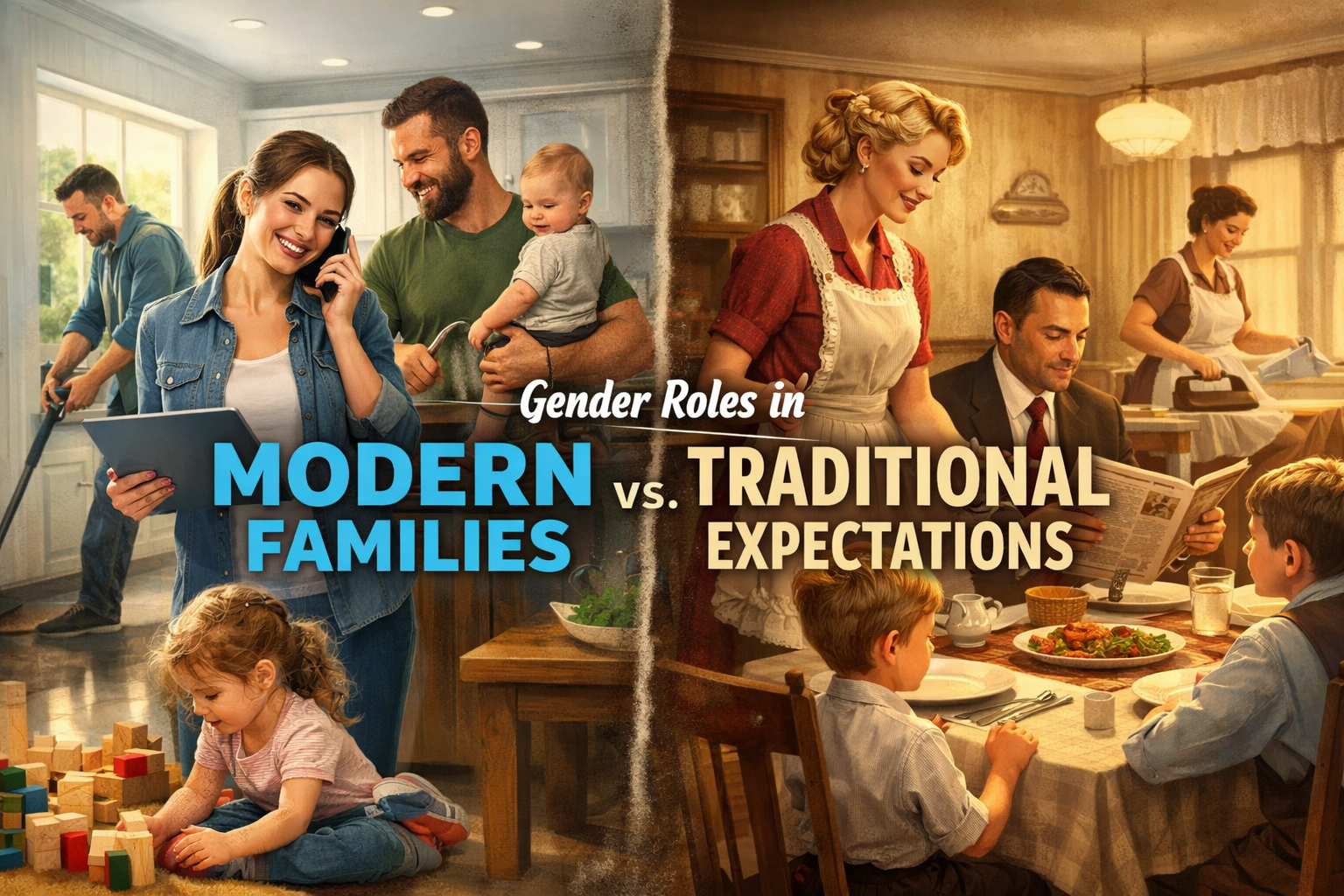
The family unit is the oldest institution in human history, yet it is currently undergoing one of its most radical transformations. For generations, the script was essentially pre-written: men were the providers, venturing out into the world to secure resources, while women were the nurturers, managing the home and raising the children. Today, that script is being furiously rewritten, crossed out, and improvised.
The transition from traditional expectations to modern family dynamics is not just a personal journey; it is a profound societal shift. It touches upon economics, psychology, sociology, and the very core of our individual identities. However, this evolution is far from complete, and it is rarely entirely smooth. As we stand with one foot in the legacy of the past and the other in the progressive ideals of the future, many families find themselves caught in a tug-of-war between what they believe is right and what societal structures actually support.
1. The Blueprint of the Traditional Family: A Historical Context
To understand the magnitude of the shift occurring today, we must first examine the foundation upon which traditional gender roles were built. The concept of the “traditional family”—often imagined as a breadwinning father, a homemaking mother, and their children—is actually a relatively recent historical phenomenon.
The Industrial Revolution and the Split of Spheres
For most of human agrarian history, men, women, and children worked alongside each other on farms or in family trades. Work and home were not separate spheres; they were inextricably linked. Both genders contributed directly to the economic survival of the household.
The true fracture occurred during the Industrial Revolution. As work moved from the farm and the home into factories and offices, a stark division emerged. The public sphere (the world of paid labor, politics, and commerce) became the domain of men. The private sphere (the home, child-rearing, and domestic duties) became the domain of women. This created an unprecedented economic dependency, as women’s labor, though essential, was stripped of monetary value.
The Post-War Boom and the 1950s Ideal
The zenith of the traditional gender role model occurred in the post-World War II era, particularly in the West. During the 1950s, an economic boom allowed a single income (typically the man’s) to comfortably support a middle-class family. Pop culture, government policies, and advertising heavily reinforced this dynamic. The image of the apron-clad mother vacuuming with a smile and the suit-wearing father returning home to read the newspaper became the gold standard of the “nuclear family.”
The Psychological Framework: Instrumental vs. Expressive
During this era, sociologists like Talcott Parsons argued that this division of labor was not just economically efficient but psychologically necessary. Parsons proposed that men naturally assumed “instrumental” roles (task-oriented, authoritative, and focused on providing), while women assumed “expressive” roles (nurturing, emotional support, and conflict resolution). For decades, this theory was treated not as a cultural observation, but as a biological imperative, cementing the idea that stepping outside these roles was somehow “unnatural.”
2. The Catalysts for Change: Dismantling the Blueprint
The rigid structures of the mid-20th century could not hold against the tidal wave of cultural, economic, and technological changes that defined the latter half of the century. Several key catalysts fractured the traditional blueprint and paved the way for modern family dynamics.
The Feminist Movements
The most prominent driver of change was the feminist movement. Second-wave feminism in the 1960s and 70s fiercely challenged the notion that a woman’s only fulfilling role was domestic. Activists fought for equal pay, access to higher education, and the dismantling of legal barriers that kept women financially dependent on men. The push for equality redefined women’s expectations of themselves and their life trajectories, insisting that women deserved access to the public sphere just as much as men.
Economic Necessity and the Dual-Income Shift
While ideology played a massive role, economics ultimately forced the hand of society. Starting in the late 1970s and accelerating through the modern era, the cost of living—particularly housing, healthcare, and education—began to outpace wage growth. The single-income middle-class family shifted from being the norm to being a luxury.
Today, the dual-income household is often an absolute economic necessity. When both partners are required to work 40 hours a week to keep the family afloat, the expectation that the woman will also shoulder 100% of the domestic labor becomes mathematically and physically unsustainable.
Technological and Medical Advancements
We cannot overlook the role of technology. The advent of the birth control pill in the 1960s was revolutionary. For the first time, women had reliable control over their reproduction, allowing them to delay marriage, pursue higher education, and establish careers before having children.
Furthermore, the proliferation of time-saving household appliances (washing machines, dishwashers, microwaves) significantly reduced the manual labor required to maintain a home, further enabling women to enter the paid workforce.
3. The Modern Family Landscape: A Spectrum of Roles
Today, the definition of family has expanded beautifully. Modern families are characterized less by strict rules and more by fluid, negotiated arrangements based on the unique personalities, careers, and preferences of the individuals involved.
The Rise of the Egalitarian Partnership
The modern ideal for many couples is the egalitarian partnership—a relationship where paid work, household chores, and child-rearing are shared equally or equitably. In these households, chores are not divided by gender (“he mows the lawn, she cooks the dinner”) but by preference, schedule, and aptitude. If the husband enjoys cooking and the wife is better at managing the family finances, they lean into those strengths.
This model requires constant communication. Because there is no default, pre-written script to fall back on, egalitarian couples must continuously negotiate their roles, adapting as careers change, children are born, and life evolves.
The Stay-At-Home Dad (SAHD) Phenomenon
One of the most visible breaks from tradition is the rise of the stay-at-home dad. While still a minority compared to stay-at-home mothers, the number of fathers choosing to be the primary caregivers has grown exponentially.
This shift often occurs for practical reasons: the mother may have a higher earning potential, or her job may provide the family’s health insurance. However, it is also a cultural shift. Modern masculinity is slowly expanding to embrace nurturing and domesticity. Men who choose to stay home are challenging centuries of stigma that equated a man’s worth strictly with his financial output.
LGBTQ+ Families: Pioneering New Norms
Same-sex couples have been quietly pioneering egalitarian family dynamics for decades. Without the default template of “husband” and “wife,” LGBTQ+ couples have historically had to build their family structures from scratch.
Studies consistently show that same-sex couples tend to share domestic duties and childcare more equally than their heterosexual counterparts. Because tasks cannot be assigned based on gender, they are naturally assigned based on capability and negotiation. Heterosexual couples increasingly look to these dynamics as a blueprint for ungendering household labor.
4. The Unseen Burden: The “Second Shift” and Mental Load
While we celebrate the progress made toward egalitarianism, we must candidly address the reality: true equality in the home is still overwhelmingly rare. Even in households where both partners work full-time, traditional expectations cast a long, heavy shadow.
The “Second Shift”
In 1989, sociologist Arlie Hochschild coined the term the “second shift.” She observed that women who worked full-time jobs would come home to a second, unpaid shift of housework and childcare. Decades later, data shows this phenomenon persists. While men have significantly increased the amount of time they spend on childcare and household chores compared to the 1960s, women still perform the lion’s share of domestic labor globally.
Defining the Mental Load (Cognitive Labor)
Perhaps the most insidious remnant of traditional gender roles is the “mental load” or cognitive labor. This is the invisible, behind-the-scenes management required to run a household. It involves anticipating needs, making decisions, and delegating tasks.
Examples of the mental load include:
- Noticing the toilet paper is running low and adding it to the grocery list.
- Remembering that a child has a friend’s birthday party on Saturday and purchasing a gift.
- Knowing when the dog needs its annual vaccinations.
- Keeping track of outgrown clothes and researching new sizes.
Even in progressive households where a man does 50% of the physical chores, the woman often acts as the “household manager.” She holds the mental blueprint of the family’s needs.
The Danger of “Helping Out”
The language we use reveals our underlying biases. It is still common to hear a father praised for “babysitting” his own children or “helping out” around the house. This framing implies that domestic work and child-rearing are inherently the woman’s responsibility, and the man is stepping in as a benevolent assistant.
In a truly modern, egalitarian family, neither partner is the manager, and neither is the helper. Both are co-owners of the domestic space. Moving past traditional expectations requires men to step up and take on not just the execution of tasks, but the cognitive burden of managing them.
5. The Ripple Effect: Impact on Child Development
The environment in which children are raised deeply influences their understanding of the world and their place within it. The shift from traditional to modern gender roles in the family has a profound, largely positive impact on child psychology and development.
Breaking the Boy/Girl Binary
Children are incredibly astute observers. When they grow up in a traditional household where Mom does all the cooking and cleaning, and Dad does all the yard work and makes the financial decisions, they internalize these roles as natural facts of life.
Conversely, when children witness a modern, fluid approach to household management, their worldview expands.
- For boys: Seeing their fathers engage in nurturing, caretaking, and domestic tasks teaches them that emotional intelligence, empathy, and cleaning are not “women’s work”—they are human life skills. It frees them from the toxic constraints of traditional masculinity that demand emotional suppression.
- For girls: Seeing their mothers as financial providers, decision-makers, and independent entities teaches them that their potential is not limited to domesticity. Research indicates that daughters of working mothers are more likely to be employed, hold supervisory roles, and earn higher incomes than daughters of women who stay home full-time.
Modeling Healthy Partnerships
Perhaps the most vital lesson modern families impart is the modeling of a healthy, equitable partnership. When parents treat each other as true equals, respecting each other’s time, careers, and contributions regardless of gender, they set a high standard for their children’s future relationships. Children learn that love and marriage are not about rigid conformity to roles, but about teamwork, mutual respect, and shared burdens.
6. Economic Realities and Institutional Lag
It is impossible to discuss the transition of gender roles without addressing the massive institutional and economic hurdles that stand in the way. Often, couples want to be egalitarian, but society structurally forces them back into traditional boxes. This is known as “cultural lag”—the phenomenon where societal ideals evolve faster than the laws and institutions that govern daily life.
The Motherhood Penalty vs. Fatherhood Bonus
In the modern workplace, men and women are treated vastly differently when they become parents.
- The Motherhood Penalty: Women often suffer a loss in wages, perceived competence, and career advancement when they have children. Employers may unconsciously (or consciously) assume that a mother will be less dedicated to her job, leading to missed promotions and the infamous “mommy track.”
- The Fatherhood Bonus: Conversely, men often experience a boost in wages and perceived reliability when they become fathers. Traditional bias leads employers to view a father as a “provider” who needs the money and will be fiercely dedicated to his job to support his family.
These biases create an economic reality where it makes more financial sense for the man’s career to take precedence, slowly pushing the couple back into a traditional breadwinner/homemaker dynamic, regardless of their original intentions.
The Paternity Leave Crisis
One of the most glaring examples of institutional lag is the lack of paid paternity leave, particularly in countries like the United States. When a child is born, if only the mother receives paid time off, she defaults into the role of primary caregiver. She learns how to soothe the baby, manage feeding schedules, and interpret cries while the father is back at work.
By the time the father returns to help on weekends, the mother is already the “expert,” and the father is relegated to the role of “helper.” Equal parenting begins on day one; without equal, paid parental leave for both partners, egalitarianism is sabotaged from the start.
7. Global Perspectives: How the World is Adapting
The tension between traditional and modern roles is a global phenomenon, but different cultures and governments are addressing it in vastly different ways.
The Nordic Model: Engineering Equality
Countries like Sweden, Norway, and Iceland are often cited as the gold standard for modern family policy. They recognize that changing culture requires changing policy.
Sweden, for instance, introduced shared parental leave in 1974. However, they realized that if they just offered the leave, women would take it all due to societal pressure. To combat this, they introduced “use-it-or-lose-it” months specifically designated for fathers. This “daddy quota” practically forced a cultural shift. Today, it is entirely normal, and expected, to see Swedish fathers pushing strollers and taking extended time off work. By normalizing male caregiving at a structural level, they have drastically reduced the cognitive load on women and minimized the motherhood penalty in the workplace.
The Developing World: A Complex Transition
In many developing nations, the shift is more complex and fraught. Rapid urbanization and globalization are pulling women into the workforce, yet traditional, patriarchal expectations remain fiercely entrenched at home. In these scenarios, the “second shift” is profoundly acute. Women are expected to be modern economic contributors by day and traditional, submissive homemakers by night.
However, even in highly traditional societies, the proliferation of internet access and global media is introducing younger generations to alternative ways of living, slowly chipping away at long-held gender norms.
8. Designing Your Family’s Dynamic: A Practical Guide
Understanding the history and sociology of gender roles is enlightening, but how does one apply this to their own living room? If you are looking to break away from traditional expectations and build a modern, equitable partnership, intention is key.
“Equality is not a naturally occurring phenomenon in a marriage. It must be aggressively manufactured and fiercely protected.”
Here are actionable steps couples can take to foster an egalitarian family dynamic:
1. Audit Your Cognitive Labor
Sit down together and make the invisible visible. Create a comprehensive list of everything it takes to run your household—not just the physical tasks (washing dishes), but the mental ones (researching summer camps, meal planning, remembering anniversaries). Seeing the sheer volume of cognitive labor on paper is often a wake-up call for the partner who has been blissfully unaware of it.
2. Shift from “Task Delegation” to “Complete Ownership”
When dividing responsibilities, do not just assign the execution of a task; assign the cognitive load attached to it. If one partner takes over the laundry, they do not just move clothes from the washer to the dryer when asked. They are responsible for knowing when detergent is low, ensuring children have clean uniforms for game day, and executing the task without needing to be reminded.
3. Have Regular “State of the Union” Meetings
Life is dynamic. What works perfectly when you have one toddler will fail completely when you have three teenagers. Modern families require regular check-ins. Set aside time weekly or monthly to discuss how the division of labor is feeling. Is one person feeling overwhelmed? Does a recent career change require a shifting of household duties? Approach these conversations as teammates solving a logistical problem, not adversaries keeping score.
4. Challenge Your Own Internalized Biases
We all carry the baggage of the culture we were raised in. Women must be mindful of “maternal gatekeeping”—the tendency to criticize how their partner does a chore (e.g., dressing the baby in mismatched clothes) and taking the task back. If you want your partner to take ownership, you must surrender control over exactly how the task is completed. Men, conversely, must actively fight the urge to wait for instructions and proactively look for what needs to be done.
5. Advocate for Structural Change
Recognize that personal choices are only half the battle. Advocate for policies in your workplace and your community that support modern families. Demand equal paid parental leave, flexible working arrangements, and transparent pay scales.
Conclusion: Embracing the Evolution
The transition from traditional gender roles to modern, flexible family dynamics is messy, complex, and highly personal. There is no single “correct” way to run a family. For some, a traditional setup where one partner provides and the other nurtures still brings genuine fulfillment and happiness, and there is absolutely nothing wrong with choosing that path—as long as it is a conscious, mutual choice rather than a default expectation.
However, for the vast majority of modern families, the rigid gender roles of the past are no longer economically viable or emotionally fulfilling. The beauty of the modern era is the freedom of choice. We are no longer bound by the biological determinism or strict societal scripts that dictated the lives of our grandparents.
By acknowledging the historical weight of these expectations, validating the unseen burdens that still exist, and consciously communicating with our partners, we can build families based on equity, respect, and individual strengths. We are in the midst of a grand social experiment, and the prize is a future where our children are not limited by their gender, but empowered by their potential.
Leave a Reply